BMI Formula: How to Calculate BMI (With Examples)
The exact math behind Body Mass Index — in kilograms and in pounds — with worked examples you can follow in under a minute.
Want to know your BMI but don't have a calculator handy? Good news — the BMI formula is one of the simplest equations in health. One division, one multiplication, and you're done.
In this guide, you'll learn the exact BMI formula in both metric (kg/m) and imperial (lb/in) units, see real worked examples, and learn how to read your result. If you'd rather skip the math entirely, our free BMI calculator does it instantly.
The BMI Formula, Explained Simply
BMI stands for Body Mass Index. It's a single number that compares your weight to your height, and it's been used since the 1830s as a quick screening tool for weight categories.
The core idea is simple:
The only tricky part? The formula changes slightly depending on whether you measure in kilograms and meters, or pounds and inches. Let's cover both. (New to BMI entirely? Start with our beginner guide: What Is BMI?)
BMI Formula in kg and Meters (Metric)
This is the original, standard version of the formula used worldwide:
Example: Calculating BMI in kg
Let's say Priya weighs 70 kg and is 1.75 m tall. Here's the calculation step by step:
Quick tip: If your height is in centimeters, convert it to meters first by dividing by 100. So 175 cm = 1.75 m. This is the most common mistake people make — more on that below.
BMI Formula in Pounds and Inches (Imperial)
If you measure in pounds and inches, the formula needs one extra ingredient — the number 703:
Example: Calculating BMI in pounds
Let's say Rahul weighs 154 lb and is 5'8" tall. First, convert his height to inches: 5 feet × 12 + 8 = 68 inches. Now the calculation:
Notice something? 154 lb is 70 kg, and 5'8" is 1.73 m — Rahul and Priya are nearly the same size, and both formulas give nearly the same answer. The math checks out. ✅
Skip the Math 🧮
Our free calculator does all of this in 2 seconds — no squaring, no converting, no 703.
Calculate My BMI →BMI Chart: What Your Number Means
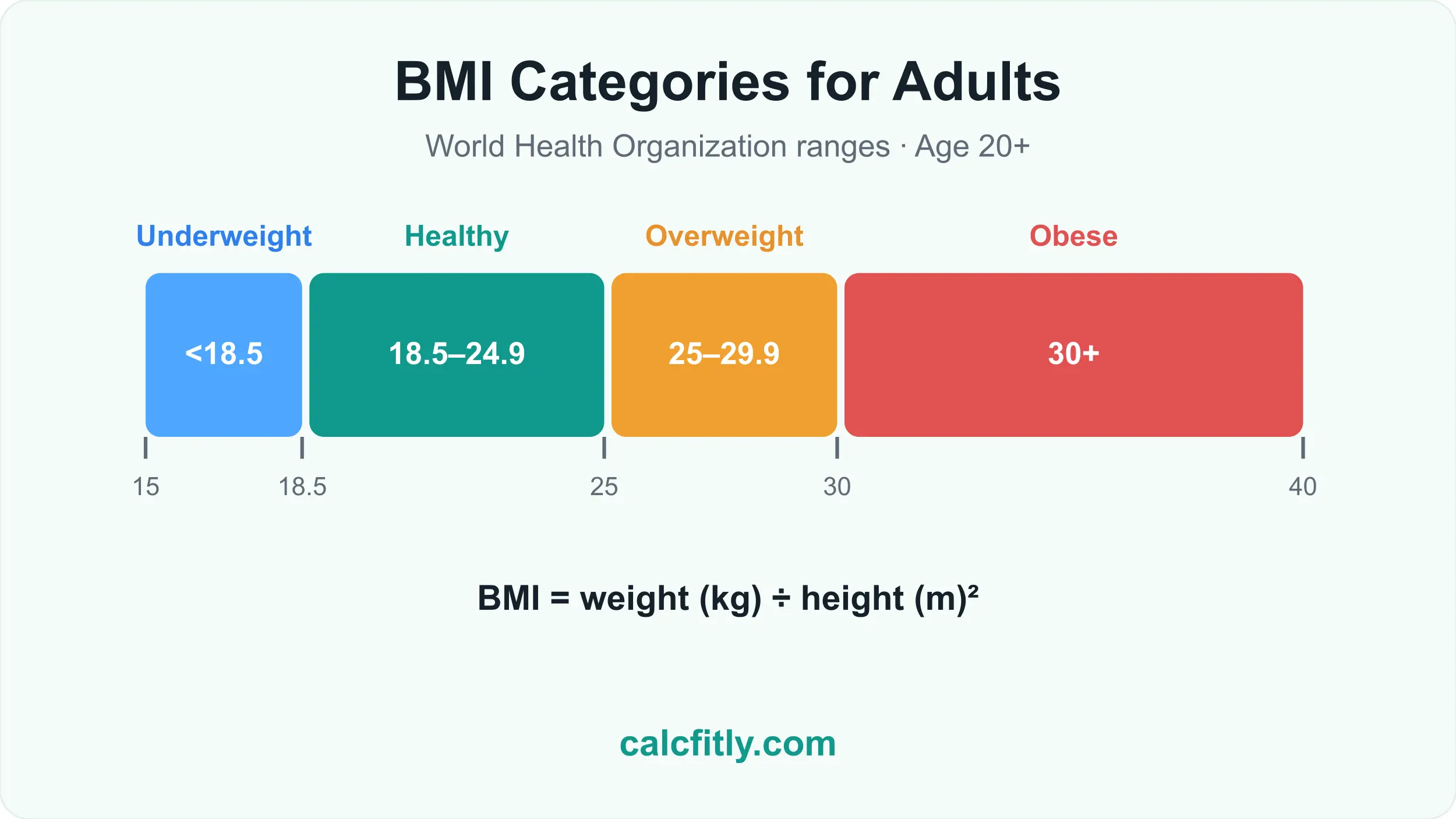
Once you've calculated your BMI, here's how to read it. These are the standard WHO categories for adults aged 20 and over:
| BMI Range | Category | What It Means |
|---|---|---|
| Below 18.5 | Underweight | May indicate insufficient nutrition or an underlying condition |
| 18.5 – 24.9 | Healthy Weight | Associated with the lowest health risk for most adults |
| 25.0 – 29.9 | Overweight | Slightly elevated risk; worth reviewing diet and activity |
| 30.0 – 34.9 | Obese (Class 1) | Increased risk of heart disease, diabetes, and joint issues |
| 35.0 – 39.9 | Obese (Class 2) | High risk; professional guidance recommended |
| 40.0 and above | Obese (Class 3) | Very high risk; medical support strongly advised |
Want to know what weight range is healthy for your height? Check our height weight chart or try the ideal weight calculator — it works the BMI formula backwards to give you a target range.
Why Does the Imperial Formula Use 703?
Fair question — it seems like a random number. It's not.
The number 703 is a unit conversion factor. One kilogram is about 2.2046 pounds, and one meter is about 39.37 inches. When you do the math to convert the metric formula into pounds and inches, the conversion works out to roughly 703 (703.07, to be precise).
Without 703, the imperial formula would give you a number about 703 times too small. A BMI of 23 would show up as 0.033 — not very useful! So the 703 simply makes pounds and inches speak the same language as kilograms and meters.
5 Common BMI Calculation Mistakes
The formula is simple, but these slip-ups trip people up all the time:
- Using centimeters instead of meters. 175 cm must become 1.75 m before you square it. Squaring 175 gives a wildly wrong answer.
- Forgetting to square the height. "Height²" means height × height — not height × 2. 1.75² = 3.06, not 3.5.
- Mixing units. Kilograms with inches, or pounds with meters, won't work. Pick one system and stick with it.
- Using feet instead of inches. In the imperial formula, 5'8" must become 68 inches — not 5.8 or 5.67.
- Rounding too early. Keep the decimals until the final step, then round to one decimal place.
Made any of these? No judgment — that's exactly why we built the BMI calculator. It handles all conversions automatically.
What BMI Doesn't Tell You
The BMI formula only uses two inputs — weight and height. That makes it fast, but also limited. It can't tell the difference between muscle and fat. A muscular athlete and a sedentary person with the same height and weight get the same BMI, even though their body compositions are completely different.
That's why BMI works best as a starting point, not a final verdict. For a fuller picture, pair it with your body fat percentage, and use our TDEE calculator to understand your daily energy needs. We cover this in more detail in What Is BMI? Complete Guide for Beginners.
Frequently Asked Questions
The BMI formula is weight divided by height squared. In metric units: BMI = weight (kg) ÷ height (m)². In imperial units: BMI = 703 × weight (lb) ÷ height (in)².
Divide your weight in kilograms by your height in meters squared. Example: 70 kg ÷ (1.75 m × 1.75 m) = 70 ÷ 3.06 = 22.9 BMI.
703 is a conversion factor that adjusts pounds and inches to match the metric formula. Without it, imperial units would give a result roughly 703 times too small.
Yes. The BMI formula is identical for adult men and women — only weight and height are used. However, the same BMI can correspond to different body fat levels in men and women.
No. Children and teens use BMI-for-age percentiles, which compare a child's BMI to others of the same age and sex. The adult formula and ranges do not apply to anyone under 20.
For adults, a BMI between 18.5 and 24.9 is considered healthy. Below 18.5 is underweight, 25 to 29.9 is overweight, and 30 or above falls in the obese range.