Your Maintenance Calories (TDEE)
0
kcal per day · BMR: 0 kcal
Find out exactly how many calories you need daily — to lose fat, maintain your weight, or build muscle.
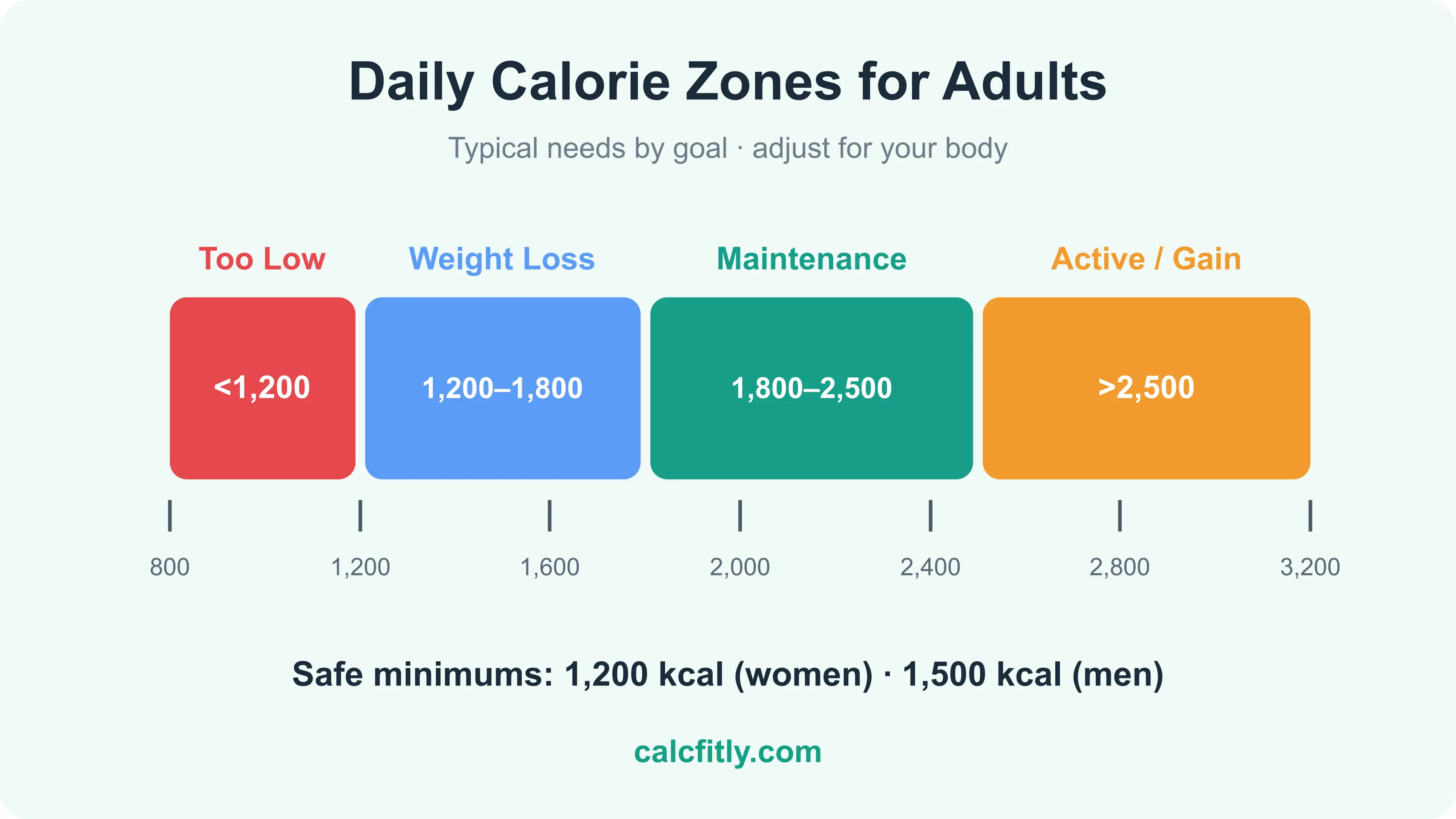
The energy math behind every body goal.
This calculator uses the Mifflin-St Jeor equation — the formula the Academy of Nutrition and Dietetics considers the most accurate for estimating your Basal Metabolic Rate (BMR):
Your BMR is then multiplied by an activity factor (1.2 to 1.9) to get your TDEE — your true daily calorie burn. That maintenance number is the foundation for every goal: eat below it to lose, at it to maintain, or above it to gain.
| Goal | Adjustment | Expected Change |
|---|---|---|
| 📉 Lose fat | TDEE − 500 kcal | ~0.5 kg loss per week |
| ⚖️ Maintain | Eat at TDEE | Weight stays stable |
| 📈 Gain muscle | TDEE + 250–300 kcal | ~0.25 kg gain per week |
Why not bigger changes? Large deficits cause muscle loss, fatigue, and rebound weight gain. Large surpluses mostly add fat, not muscle. Slow and steady genuinely wins this race.
| Group | Sedentary | Moderate | Active |
|---|---|---|---|
| Women (19–30 yrs) | 1,800–2,000 | 2,000–2,200 | 2,400 |
| Women (31–50 yrs) | 1,800 | 2,000 | 2,200 |
| Men (19–30 yrs) | 2,400–2,600 | 2,600–2,800 | 3,000 |
| Men (31–50 yrs) | 2,200–2,400 | 2,400–2,600 | 2,800–3,000 |
These are population averages — your personal number from the calculator above will be more accurate because it uses your exact stats.
Quick answers to common calorie questions.
It depends on your age, gender, weight, height, and activity level. Most adult women need 1,600–2,400 kcal daily, and most adult men need 2,000–3,000 kcal. Use this calculator for your personal number.
Eat about 500 kcal below your maintenance calories (TDEE). This creates a deficit that leads to roughly 0.5 kg of fat loss per week. Never go below 1,200 kcal (women) or 1,500 kcal (men) without medical supervision.
It's the formula used to estimate your Basal Metabolic Rate (BMR) — the calories you burn at rest. The Academy of Nutrition and Dietetics considers it the most accurate BMR formula for most people.
No. Most people track for a few weeks or months to learn portion sizes and food values, then maintain their results with mindful eating. Tracking is a learning tool, not a life sentence.
Common reasons: underestimating portions, overestimating activity level, or water retention masking fat loss. Track honestly for 2–3 weeks, and if weight hasn't moved, reduce by another 100–200 kcal.
For weight loss, yes — a calorie is a calorie. But for health and hunger, no. Protein keeps you fullest, fiber-rich carbs digest slowly, and highly processed foods are easy to overeat. Quality matters for how you feel.
No. All calculations run entirely in your browser. Your details and results are never stored or sent anywhere.
Split your daily calories into the perfect protein, carbs, and fat targets.
Try Macro Calculator — Free