Find your Total Daily Energy Expenditure — the exact number of calories your body burns every single day.
📊 Your TDEE at every activity level:
| Activity Level | Calories/Day |
|---|---|
| Sedentary (little/no exercise) | 0 |
| Light (1–3 days/week) | 0 |
| Moderate (3–5 days/week) | 0 |
| Active (6–7 days/week) | 0 |
| Very Active (physical job) | 0 |
The master number behind every successful diet plan.
TDEE = BMR × Activity Factor
Your Total Daily Energy Expenditure is built in two steps. First, we calculate your BMR (Basal Metabolic Rate) — the calories your body burns at complete rest — using the Mifflin-St Jeor equation, which the Academy of Nutrition and Dietetics considers the most accurate formula for most people:
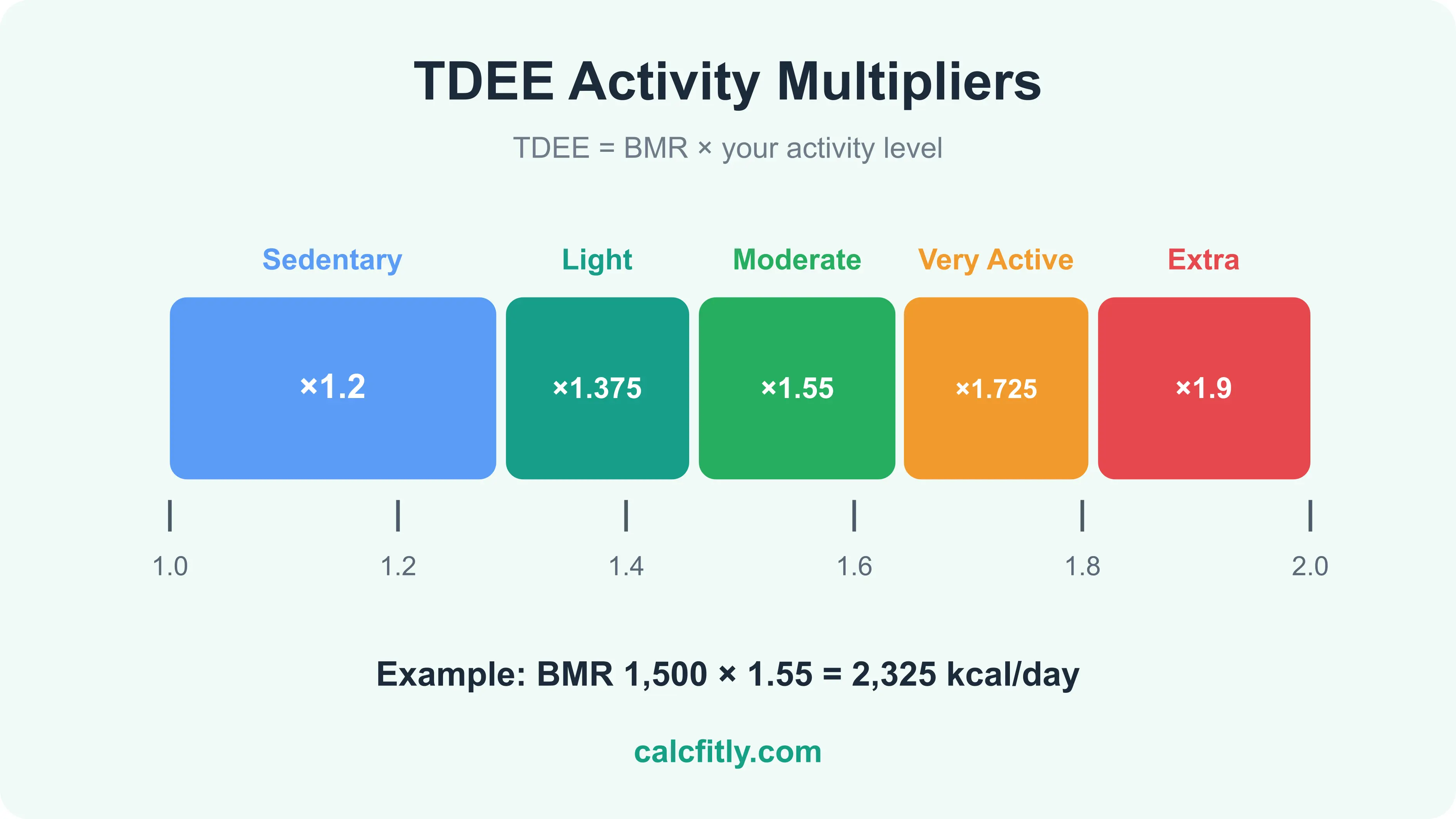
Then we multiply your BMR by an activity factor that reflects your lifestyle:
| Activity Level | Multiplier | Who Is This? |
|---|---|---|
| Sedentary | × 1.2 | Desk job, little or no exercise |
| Light | × 1.375 | Light exercise 1–3 days per week |
| Moderate | × 1.55 | Exercise 3–5 days per week |
| Active | × 1.725 | Hard exercise 6–7 days per week |
| Very Active | × 1.9 | Physical job plus daily training |
Many people confuse these two numbers, but they serve very different purposes:
This is why you should never eat below your BMR for extended periods — it's the minimum fuel your body needs to function properly. Your TDEE, on the other hand, is the number you base your diet plan on.
Once you know your TDEE, reaching any body goal becomes simple math:
Important: These are starting points, not guarantees. Track your weight for 2–3 weeks and adjust by 100–200 kcal if you're not seeing the expected change.
Your daily calorie burn comes from four sources:
Your TDEE isn't fixed — it changes as your body changes. Recalculate when:
Remember: any calculator gives an estimate. Your real-world results over 2–3 weeks are the ultimate truth — adjust your intake based on what the scale and mirror tell you.
Quick answers to common TDEE questions.
TDEE (Total Daily Energy Expenditure) is the total number of calories your body burns in a day, including all activities — from breathing and digestion to exercise. It's calculated by multiplying your BMR by an activity factor.
TDEE = BMR × Activity Factor. We first calculate your BMR using the Mifflin-St Jeor equation, then multiply it by a factor (1.2 to 1.9) based on how active you are.
BMR is the calories you burn at complete rest (just staying alive). TDEE includes everything — walking, working, exercising, and digesting food. TDEE is always higher than BMR.
Eat fewer calories than your TDEE. A deficit of 500 calories per day leads to roughly 0.5 kg of fat loss per week. To gain muscle, eat 250–300 calories above your TDEE.
No. All calculations run entirely in your browser. Your details and results are never stored or sent anywhere.
Not exactly. Your TDEE varies day to day based on how much you move. The calculator gives your average based on your typical activity level. On very active days you burn more; on rest days you burn less. This is why weekly averages matter more than any single day.
Most people overestimate their activity level. An hour at the gym doesn't fully offset 8+ hours of sitting. If your result seems low, try the "Light" or "Sedentary" level, eat to that target for 2–3 weeks, and adjust based on your actual results.
Split your calories into the perfect protein, carbs, and fat targets.
Try Macro Calculator — Free