Check your Body Mass Index in seconds — and see your healthy weight range for your height.
What your Body Mass Index really tells you — and what it doesn't.
BMI (Body Mass Index) is a simple screening tool that compares your weight to your height. It was developed in the 1830s by Belgian statistician Adolphe Quetelet and is still used worldwide by doctors and health organizations as a quick first check:
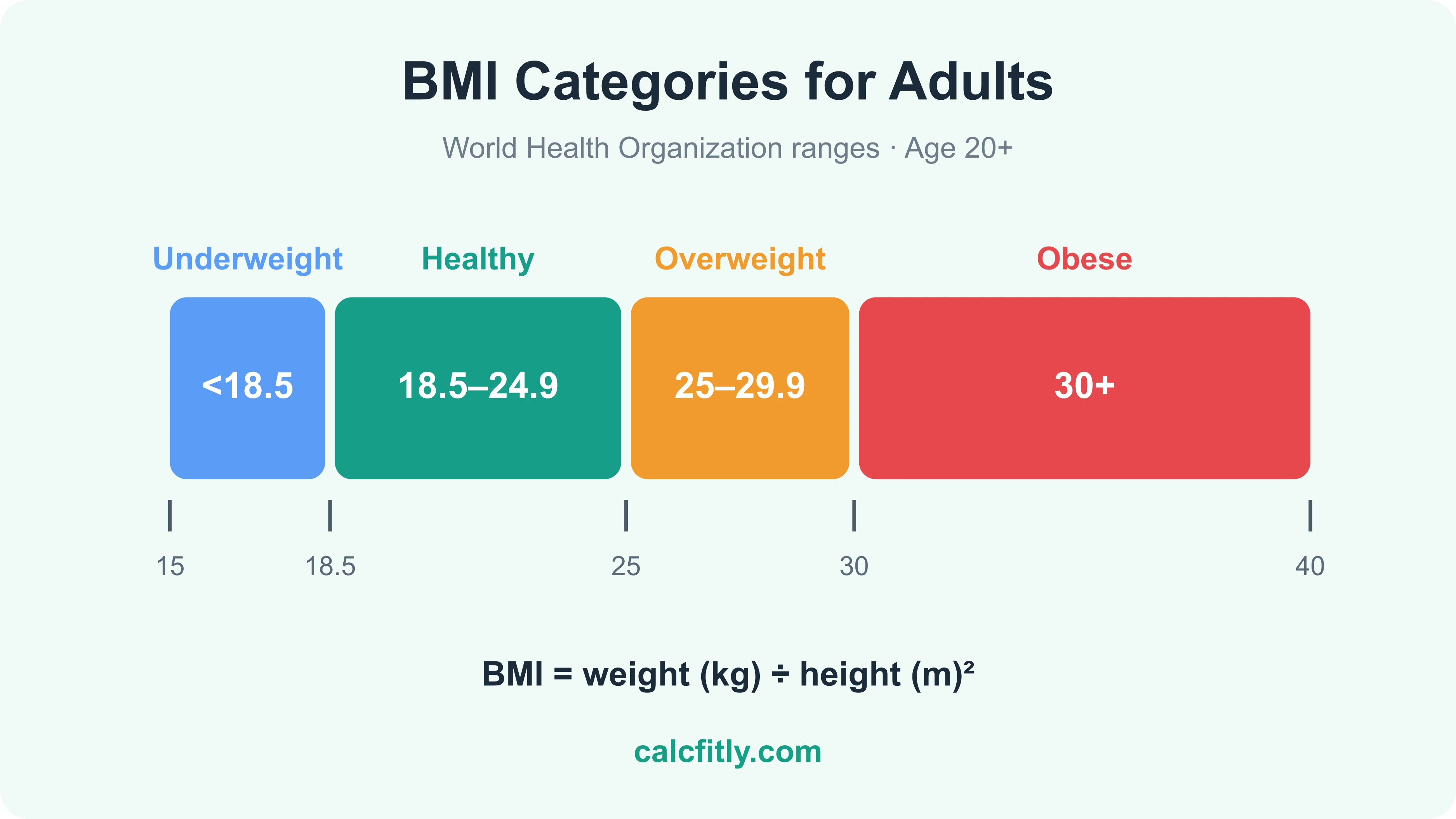
BMI = weight (kg) ÷ height (m)²
For example, a person weighing 70 kg at 1.75 m tall has a BMI of 70 ÷ (1.75 × 1.75) = 22.9 — right in the healthy range. The formula works the same for men and women, and it takes just seconds to calculate, which is exactly why it remains so popular nearly 200 years later.
| BMI Range | Category | What It Means |
|---|---|---|
| Below 18.5 | Underweight | May indicate malnutrition or other health issues |
| 18.5 – 24.9 | Healthy Weight | Associated with the lowest health risks |
| 25.0 – 29.9 | Overweight | Slightly elevated risk; lifestyle changes help |
| 30.0 – 34.9 | Obese (Class I) | Increased risk of heart disease, diabetes |
| 35.0 – 39.9 | Obese (Class II) | High risk; medical guidance recommended |
| 40.0+ | Obese (Class III) | Very high risk; professional support advised |
BMI is useful, but it's not perfect. It doesn't measure body fat directly — it only compares weight and height. This means:
Bottom line: Use BMI as a starting point, not a diagnosis. For a fuller picture, pair it with body fat percentage, waist measurement, and how you actually feel.
These two measurements answer different questions. BMI tells you if your weight is appropriate for your height. Body fat percentage tells you what your weight is actually made of — fat versus muscle, bone, and water.
Two people can have the exact same BMI of 27: one might be a muscular athlete with 12% body fat, while the other is sedentary with 32% body fat. Same BMI, completely different health profiles. If you exercise regularly, body fat percentage is usually the more meaningful number to track.
Quick answers to common BMI questions.
A healthy BMI for adults is between 18.5 and 24.9, according to the World Health Organization. Below 18.5 is underweight, 25–29.9 is overweight, and 30 or above is obese.
BMI = weight in kilograms divided by height in meters squared. For example, 70 kg at 1.75 m: 70 ÷ (1.75 × 1.75) = 22.9. In imperial units: BMI = 703 × weight in lbs ÷ height in inches squared.
Not always. BMI can't tell the difference between muscle and fat, so very muscular people often register as "overweight" despite being extremely healthy. If you train regularly, body fat percentage gives a much clearer picture of your health.
For adults aged 20 and over, the healthy range is 18.5–24.9 regardless of age. Some research suggests older adults (65+) may do best at the higher end of that range. Children and teens use completely different age-specific charts.
The BMI formula and categories are the same for adult men and women. However, women naturally carry more essential body fat than men at the same BMI, which is why body fat percentage categories differ by gender.
A modest calorie deficit of 400–500 kcal per day leads to steady fat loss of about 0.5 kg per week. Combine this with protein-rich meals, regular walking or exercise, and 7–9 hours of sleep for the best results.
No. All calculations run entirely in your browser. Your height, weight, and results are never stored or sent anywhere.
Find out how many calories you need daily to reach your goal weight.
Try Calorie Calculator — Free